The best books on writing (if you ask me)
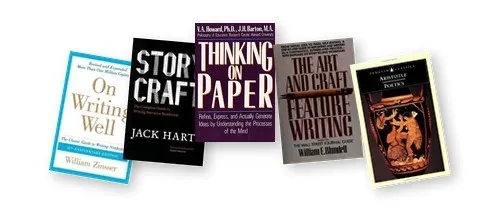 I was rearranging my bookshelf the other day when I decided to group all of my books about writing and journalism into one specific section. I counted 27. Whether that’s an impressive amount I don’t know, but I can at least say I’ve read every one of them from cover to cover. That must count for something.
The collection spans everything from the extremely practical — how to take notes, how to prepare for an interview — and then the more existential in our age of AI:
What is a story? What is writing, and why do we do it?
I have all these writing books because I fell into a trap. To become a better writer, I reasoned, I needed to read books about writing. Thankfully, I’ve snapped myself out of that, these days heeding more closely the advice of the great BBC journalist Allan Little, who, in a beautifully crafted training video, said this:
“It sounds obvious, too obvious to state maybe, but if you want to be a good writer, you have to read books, not just newspapers. To use this language well, you have to love it. Build some time into your daily life for reading. Read poetry, read it slowly. Think about the way the writer bends the language to his needs.”
In other words, the only true path to becoming a better writer is through reading great writing. That's more often found in the fiction section. You’ll develop remarkable skills through osmosis, instinctively picking up lessons about atmosphere and rhythm, sentence structure and tone, like a child learning its first language. Isn’t that wonderful? All you need to do is entertain yourself and get a good night’s sleep now and again. Your subconscious has been taking notes and you’ll soon reap the benefits.
Now, if you’re one of the stubborn people — likely a man — who can’t bear to drift from non-fiction, at least try your best to gravitate towards those skilled enough to turn facts into a hearty tale. The works of Patrick Radden Keefe (Say Nothing; Empire of Pain), Erik Larson (Devil in the White City; In the Garden of Beasts) and Robert Caro (The Power Broker) are great places to begin.
All that said, the best books on writing are immensely valuable.
The following books are ones I have returned to often. Sometimes it’s because I’m stuck in a rut of bad habits. Maybe I’ve slipped into my typical disorganization around note taking, or my ledes have become too formulaic. I’m almost always suffering from impostor syndrome, and it’s encouraging to learn that someone like Caro, one of the world’s most gifted and creative biographers, once felt it necessary to take a creative writing course — as did many other great writers you know.
Each book here offers something different while sharing important qualities. First and foremost, they are, in and of themselves, superb pieces of writing. Clear, efficient, engaging, fun. You’d think all books about writing would be like this but I can tell you that is absolutely not the case.
Second, they won't patronize you. They discuss writing for what it really is — a muscle you can make stronger — rather than some divine gift that descends from the heavens and flows out through your fingers. All these authors know, intimately, that writing is an act of hard work. Drudgery. It requires obsessive revision and overcoming crippling self-doubt. They also know how to make you want to still do it anyway.
Finally, even though several are many decades old, and one several centuries, they all have sharp relevance to modern writing in our attention-span challenged times.
I hope you find them as useful and inspiring as I have.
ON WRITING WELL William Zinsser (1976, last updated in 2006)
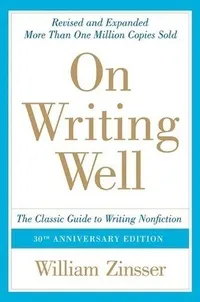
My Amazon purchase history tells me I’ve bought this book no fewer than five times. It’s the book I have given to anyone who uttered the phrase “I’m not a good writer” or “I can’t write” within my earshot. It’s the writing book I’d recommend to you if I could only pick one.
William Zinsser, an ex New York Herald Tribune writer turned Columbia journalism professor, obsesses over convention but does it in a way that makes you like him and want to meet his standards; to appeal as best you can to his evidently impeccable taste.
The most useful chapter, the one that sits in the back of my mind as I write just about anything, comes early on. It’s about simplicity. Showing some of his own work — indeed, a draft of the very chapter you’re reading at that moment — Zinsser whittles away like a sculptor, reducing each sentence and passage to its tightest and clearest form. “A clear sentence is no accident,” Zinsser writes. It’s probably the single most important principle you can learn.
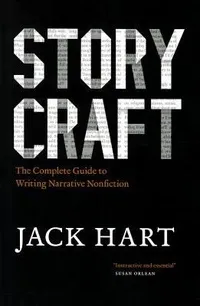
WORD CRAFT and STORY CRAFT Jack Hart (2021)
When you read a Pulitzer Prize-winning piece, you don’t feel as though you’re bouncing from quote to quote, or scene to scene. Each section makes natural sense, the reader flowing through as though sailing a boat downstream, briefly stopping here and there on tangents but making almost constant and satisfying progress towards a conclusion. When it works well, it looks effortless. If you want an example, try this moving piece about the San Quentin prison marathon.
In his two books, Jack Hart, former managing editor at the Oregonian, breaks down the component parts required for a great longform writing. I was introduced to his books by Matt Vella, the tremendously creative editor of the Financial Times magazine. He suggested Hart’s guides as the best introduction to narrative structures, helping you consider not just the information contained within each section, but how that information should be delivered, and what emotional or practical purpose it serves.
Word Craft is a broader view on good writing, while Story Craft goes deeper on writing specifically journalistic features and narrative non-fiction. Both books share the same practical quality. Like many an editor I’ve met in my career, Hart is one of those people who can tell you he can take a dogs dinner of a story and turn it into something wonderful — provided, that is, the raw material is up to it. And that’s where Hart’s books excel. They teach you how to think about the final product early enough so that you can be a more effective and focused gatherer.
THE ART AND CRAFT OF FEATURE WRITING William E. Blundell (1988)
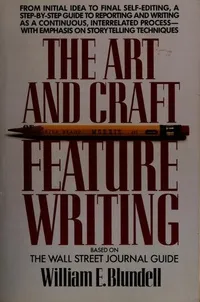
That boat/stream metaphor I used above? I stole it from William E Blundell, whose book on feature writing is canon for those in the news business.
One former FT colleague, Sarah O'Connor, said it would be her one book to save from a burning building. She wrote:
“I like to re-read it from time to time to remind myself not to slip into bad habits — for example, to ‘call a spade a spade, instead of bringing in someone from Harvard to solemnly declare it a long-handled personal earthmoving implement’.”
Blundell was a features writer and then editor at the Wall Street Journal, a paper which, like the FT, makes its money by helping people with money make even more of it. It helps, then, if its writers can see at least partly into the future with their reporting, scoping out cause and effect when they sit down to plan and write.
Blundell breaks down one of those perennial dinner party questions aimed at journalists: How do you decide what to write? Where do you get your ideas?
Too many books on journalism brush off these questions with unhelpful pointers like “tap your sources” or “pick up the phone”. In Blundell’s guide, he scopes out how a reporter (or anyone researching anything) can actually sit down and break even the most complex-looking story arc into a case of this-then-that, making the journey ahead less daunting. Most useful for me was his advice on how not to over-report — a nasty affliction that leaves many journalists dreading the process of actually sitting down to write.
What I like most about Blundell’s book is that he’s not afraid to admit an awkward truth of business journalism, which is that sometimes there’s no avoiding boring people or topics. I’ve found other writing books gloss over this inconvenience. Find someone or something more interesting, they instruct, too scared to admit that’s not a luxury most journalists get to enjoy. Blundell teaches how to bring character to the characterless.
POETICS Aristotle (335 B.C)
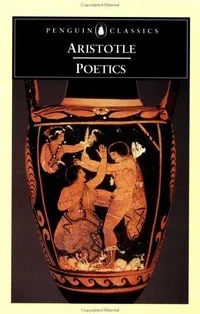
Ooh, la-de-da, he’s picked a Greek philosopher. Indeed I have, although what I’m really recommending is this slightly more user-friendly guide to Poetics that is both in English and broken down for the newbie. An idiot's guide, if you will. It takes Poetics and sets it up in more familiar terms: How to Tell a Story.
Now, I’m not recommending any journalist or writer sit in front of their computer pondering how Aristotle might have tackled whatever writing task lay before them. No, the point of reading this book is to be reminded of just how simple our little brains really are. How, for centuries, the basic story components that compel us to keep reading, to become engorged in a story, are as effective today as they ever were. It will help you spot the telltale signs of the story arcs that scratch our brains the most, like a victorious underdog, or a comeuppance.
You know all these things instinctively, but reading Aristotle’s work — or at least, this simplified version of it — will help you break down the reasons why we are how we are, and how you can best tap into that.
THINKING ON PAPER V.A Howard & J.H Barton (1986)
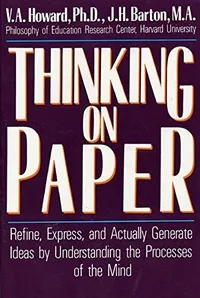
This book is at the end of the list because it’s only really a partial recommendation, since I promised you back up there that everything here would have modern relevance. Thinking on Paper, while groundbreaking for its time, drifts often into advice suited to a bygone era. The authors, two Harvard professors, also try to impose what works for them onto the aspiring writer, with what to me reads like little acknowledgment of the possibility that their way might not work for everyone.
I include it anyway because of the book's bigger picture, which is trying to define what exactly writing is for.
The simplest answer is that we write things so people read them. Peel another layer and you might say we write to be heard, understood or, if we’re really lucky, heeded.
What Thinking on Paper manages to do is get even deeper than that — providing what was, for me, a deeply revelatory moment. The book demonstrates how writing can be used to break down ideas, or stress test a thesis; free from the shackles of knowing your words will be read by someone else, like your boss, your editor, or the whole world of readers.
It helped me overcome a problem that I’m sure many of us have faced. That moment when you sit down to write, on deadline, and as you do, all the things you don’t know, or wish you could have got, become suddenly obvious to you — but by then it's too late. It’s perhaps the most demotivating feeling a writer can experience: Knowing what could have been.
Following the advice of Howard and Barton will reduce this problem. Just don’t feel guilty if you skip the entire first half of the book.
One final thought before I go. There’s a couple of things you may feel are missing from the list. The first is Stephen King’s On Writing which, I’m told, is a very good book, but one I haven’t read because I don’t like Stephen King’s writing all that much.
The second is more problematic. There are no books on this list by women. I can assure you it's not a conscious decision, but I have no explanation for it other than I haven’t been trying hard enough, so I will change that. Recommendations very welcome.