Blog
"One's output must never exceed one's input."
So said a wise former editor of mine. So, from the vast jumble of words that I read each day, here's some interesting reads and notable work from talented human beings. Inspired by Kottke.org.
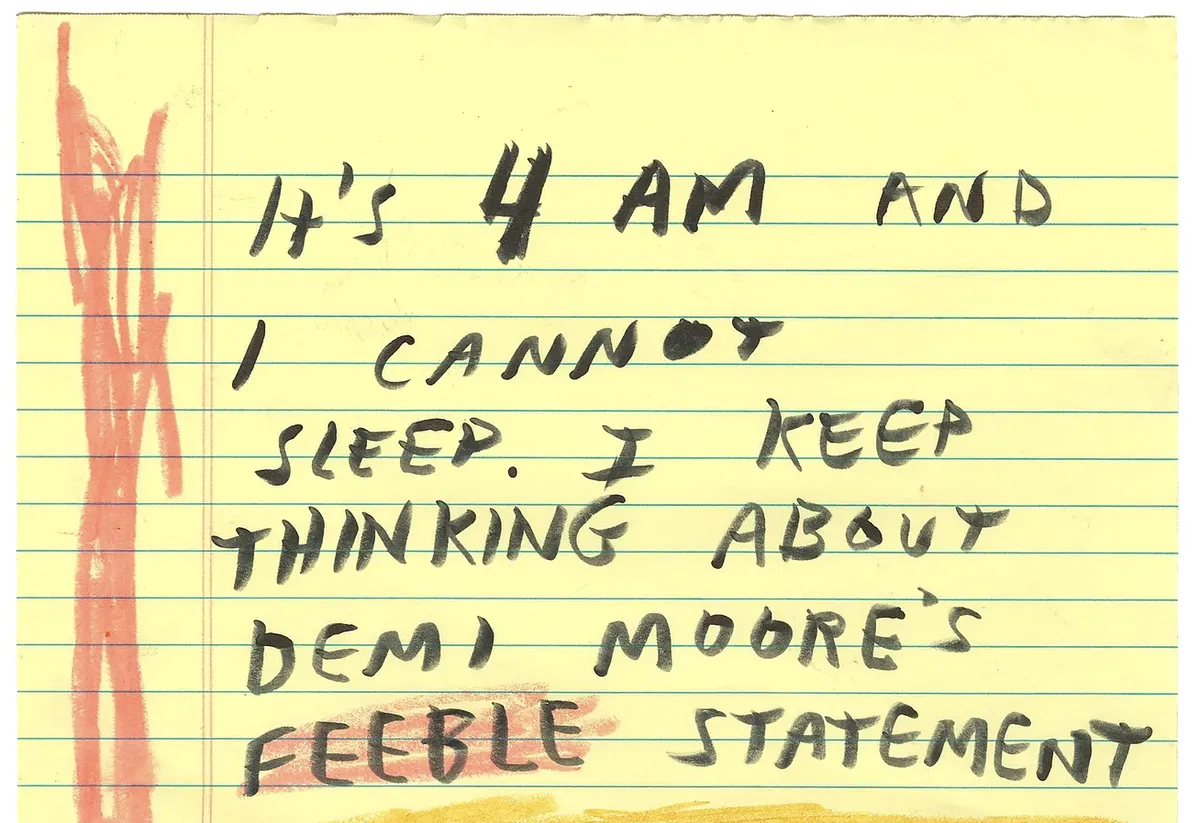
- Demi's feeble A.I. statement
-
State of perpetual self-surveillance
The internet teems with a veritable cottage industry of corrective dressing, offering guides on how to dress for every shape imaginable. Large men, we’re told, shouldn’t wear horizontal stripes because they make you look wider. Short men shouldn’t wear cuffed trousers because they truncate the leg line. These rules are dressed up as practical advice, but they rest on shaky logic and accept the fashion industry’s standards as law.
Follow these too closely and you’ll enter a state of perpetual self-surveillance, forever asking whether a garment diminishes or exaggerates some defect that you see in yourself. The result is self-consciousness and anxiety, pushing you toward clothes that conceal rather than express, ultimately producing the opposite of style.
Instead of leading with body type, start with the cultural language of dress. We no longer live in a world where a single class sets the terms for how men should appear. This has made the task of dressing more complicated, but also more pleasurable.
Read it all: How To Dress Well For Any Body Type
-
An institutional feel
A really peculiar story in the New Yorker, meticulously reported:
“When the police entered the mansion, they were surprised to find that it had an institutional feel. There were CCTV cameras everywhere, bedrooms filled with cribs, and, in classrooms downstairs, more than a dozen children seated at desks in front of whiteboards. It was impossible to tell the girls and boys apart, since all of them had shaved heads.”
Read it all: The fate of twenty-one Los Angeles siblings
-
Sell my socks
Matt Levine is a genius. On GameStop CEO Ryan Cohen's whacko bid to acquire eBay:
[S]ometimes a potential buyer will lob in a bid without the money, and the target will say “okay do you have the money,” and the buyer will say “yes I have a quadrillion dollars in my account at the Vatican Bank,” or “yes I have plenty of money in ancient Mesopotamian bearer bonds,” or “no but I know where Yamashita’s gold is buried and if you finance my expedition I can dig it up,” or “I can turn lead into gold with my mind,” or “money isn’t real man,” or “what? I can’t hear you, I’m going through a tunnel,” or — and I cannot stress this enough — “I’m going to sell my socks on eBay to finance the takeover.”
(Cohen was "selling" his socks in eBay to finance the takeover -- until his account was suspended.)
-
Hope is always the only rational position
Author Alan Moore speaking in February 2025 to fan site ALANMOOREWORLD (and what a rich world that is):
Q: What do you think of the current political situation in the world? Can we reasonably have hope, or is the scenario inevitably gloomy for Humanity?
Alan Moore: My answer is both. Hope is always the only rational position, in that to give up hope of success is to guarantee failure and, in the event that the worst happens, it is surely better to go out knowing that you resisted it and struggled your very best to prevent it from happening. So, yes, there is always hope. But, yes, I fear that the world is inevitably in for a gloomy period, and the hope is that we can survive it and build something better from it.
If we wish to have an inhabitable future for us and our children and their children, then might I quietly suggest we stop electing and tolerating obvious fascist buffoons because we think they’re entertaining characters, as if they were housemates on Big Brother. This isn’t reality TV. This is reality, or what’s left of it. Let us instead protest and rail at these dribbling Nazi idiots to our last breath, rather than beam stupidly as Elon Musk ‘sends his heart out to us’ Nuremberg style. Let us point out that they are suicidal cretins when they insist that climate change is a Chinese hoax. Let us not give these witless fuckers an inch.
And, more important than condemning the forces driving this multi-faceted disaster, let us take responsibility for ourselves and our communities. Let us for God’s sake stop relying on these leaders and their self-serving social structures that lead us nowhere save into the abyss. If we want things to exist – things like proper education, health and welfare services – then let us give our energies, our time, our money, our art, to the numerous community projects that are springing up of necessity and attempting to counteract these privations of the state or the toxic world it has created. Support environmental movements and protests, stand up for the rights of minorities and women at a moment when those rights are being clawed away from them by the horror story/laughing stock currently in the White House, form Arts Labs or start fanzines in recognition of the fact that we should probably think about providing our own art and entertainment too, and do something, some little or big thing to make the world around you more like the world you want to live in.
Good luck.
(h/t Tony Wolf on Bluesky.)
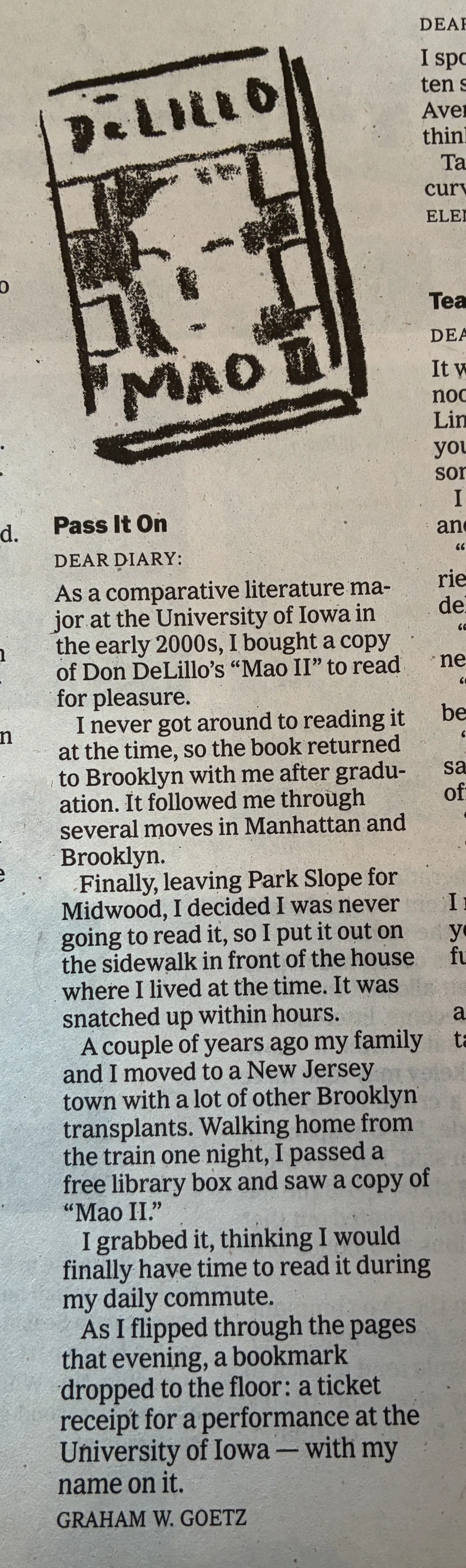
- Mao II
-
Even the Mets
A charming correction from the New York Times:
Because of an editing error, an earlier version of this article misstated which day the New York Mets suffered their 11th straight loss. It was on Sunday, not Monday. Even the Mets cannot lose on an off day.
Baseball always brings out the best in American newspapers, especially when the subject is crushing and unrelenting defeat. Here's a tremendous passage from a New York Times report on the Chicago White Sox's 2024 season:
Over the course of the 2024 season, the White Sox have explored the full spectrum of losing the way a great actor uses every corner of the stage, the way a jazz saxophonist probes every note in a scale. They have lost nobly, tragically, cleverly, inspiringly and deflatingly. They have lost late at night and early in the afternoon, in soggy rain and on crisp sunny days. I have seen perfectly professional losses that could have gone either way — but of course didn’t — and games that should have been stopped, for cruelty, in the fourth inning. I have seen the White Sox lose in front of huge roaring crowds at Fenway Park and also, back home, in their own nearly empty stadium. (On a sunny Tuesday, just before game time, I once counted 199 people sitting in the vast sea of outfield seats — and when the announcer finally said “Play ball!” the applause sounded like someone had just done a magic trick at a church picnic.) I have seen the White Sox hit their catcher in the groin with the baseball three separate times in a single inning. I have seen the White Sox lose because three fielders ran into each other like clowns. I have watched a bloop single flutter and fall, like the first leaf of autumn, delicately onto the outfield grass, at the most devastating possible moment. I have seen games in which Chicago’s hitters looked like All-Stars but their pitchers looked like impostors, and games where it was vice versa, and games in which they all played great but the ball just bounced the wrong way.
For more great writing on baseball and the meaning of defeat, check out Can't Anyone Here Play This Game?, by the incomparable Jimmy Breslin.
-
Ping pong bot
Reuters reports on Ace, a ping pong-playing robot created by AI researechers at Sony, was able to beat some of the world's best human players.
Will Dunham writes:
In matches detailed in the study, Ace in April 2025 won three out of five versus elite players and lost two matches against professional players, the top skill level in the sport. Sony AI said that since then Ace beat professional players in December 2025 and last month.
Of course, Sony's ambition here isn't to make a champion table tennis player, fun as that is. Broader applications can follow:
The project's goal was not only to compete at table tennis but to develop insights into how robots can perceive, plan and act with human-like speed and precision in dynamic environments, Dürr said.
"The success of Ace, with its perception system and learning-based control algorithm, suggests that similar techniques could be applied to other areas requiring fast, real-time control and human interaction - such as manufacturing and service robotics, as well as applications across sports, entertainment and safety-critical physical domains," said Dürr, lead author of a study describing Ace's achievements published on Wednesday in the journal Nature.
At some point I'm sure someone will come up with some kind of Humans v Robots Olympic Games. Though how long that will last is questionable. At a certain point the robots will just never lose.
-
ChatGPT's gender gap has closed
Interesting data from Nicholas Thompson of the Atlantic:
"Because we are asking it about our relationships" offers a woman in Thompson's comments, though we're just as likely to hear about men turning to AI for relationship advice as women. Another comment speculates that this shift was inevitable as AI matured into a mainstream tool, which is about where we are now.
-
Be nice to your chatbot
Casey Newton:
Being polite to a large language model can feel strange or even silly — roughly equivalent to thanking a toaster. And yet a recent paper from Anthropic lends scientific weight to the theory that chatbots work better when you’re nice to them.
The researchers found that language models have fairly reliable internal representations of feelings like “happiness” and “distress,” and that these representations affect their behavior — sometimes for the worse. For example, when Claude Sonnet 4.5 begins to represent “desperation,” the model is more likely to cheat at coding tasks.
Read more: The scientific case for being nice to your chatbot